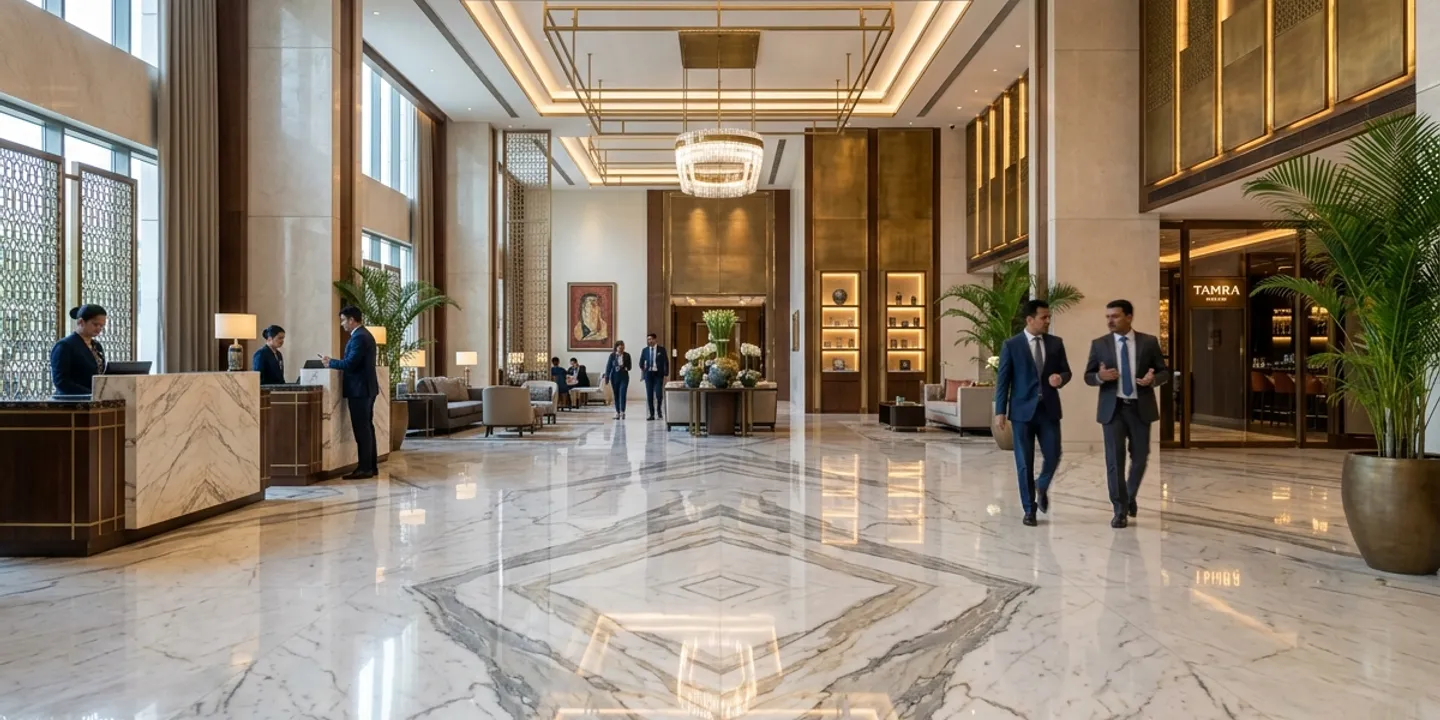
Executive Summary: Museum-Grade Natural Stone Craftsmanship
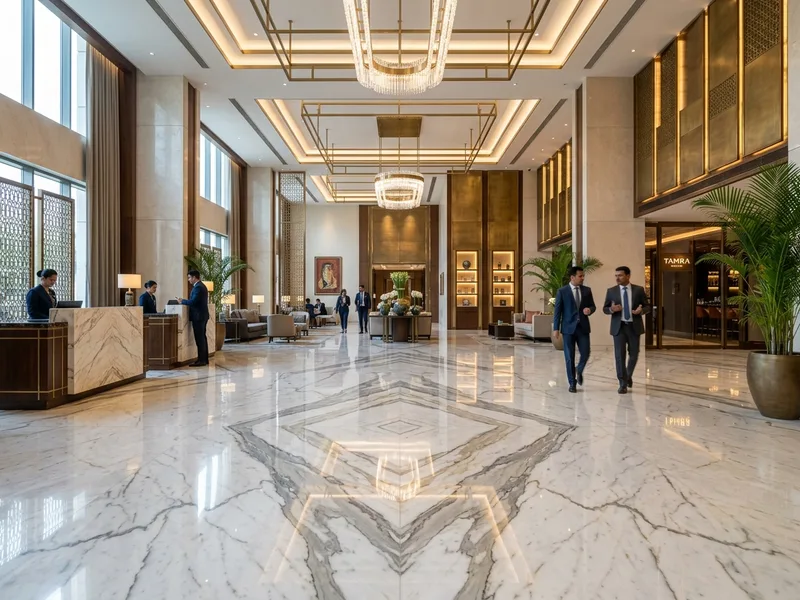
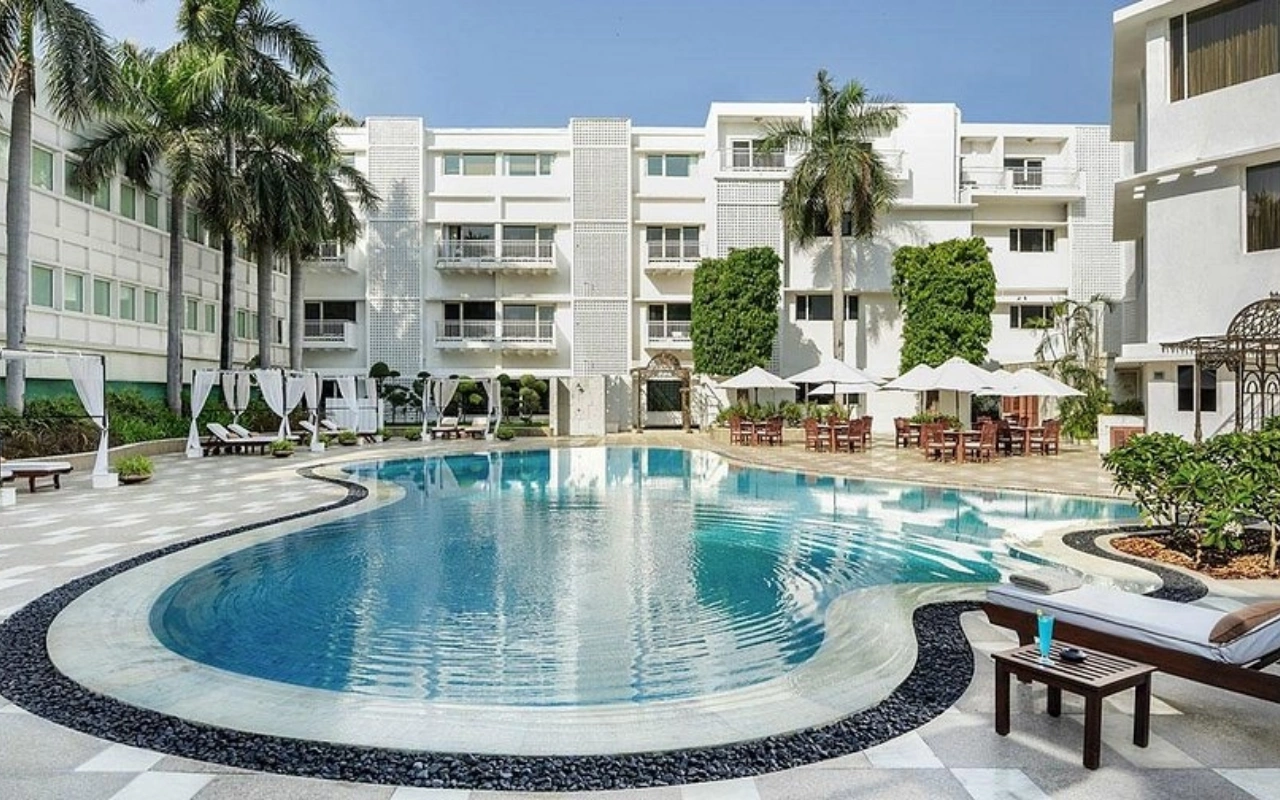
Situated on Dr APJ Abdul Kalam Road in the prestigious heart of Lutyens' New Delhi, The Claridges Hotel represents an iconic legacy of colonial architectural elegance and five-star deluxe hospitality. Undertaking major architectural surface upgrades in an operational heritage landmark requires extraordinary discipline: flawless vein continuity, zero floor lippage, and dust-free execution protocols to safeguard guest experience.
As part of our specialized turnkey capabilities alongside commercial civil and architectural finishing, Parth Enterprises was entrusted with the specialized Italian marble procurement, dry-grid bookmatching, surgical installation, and high-gloss diamond silicate crystallization across 25,000+ sq.ft of the grand lobby, central atrium, and VIP presidential corridors. Utilizing our proprietary 7-stage planetary diamond honing and silicate hardening procedure, we achieved an extraordinary 92+ Gloss Unit (GU) mirror finish with seamless veining across extensive architectural spans.
Craftsmanship Excellence Standard
100% Vein Harmony: Prior to chemical installation, every imported Italian Statuario slab underwent full dry-grid mockups on staging platforms, aligning vein directions and bookmatch patterns with zero visible discontinuity or tonal clash.
The Heritage Hospitality Challenge & Site Brief
Unlike new construction, installing premium natural stone in an operating luxury hotel demands surgical precision and strict operational containment:
- Zero Noise & Dust Containment: Work zones immediately adjacent to luxury guest check-in lounges and fine-dining restaurants required negative-pressure air filtration and floor-to-ceiling acoustic barrier partitions.
- Structural Weight Restrictions: Working over historic floor slabs required lightweight, polymer-modified adhesive beds (8–12mm) rather than traditional thick mortar screeds to prevent structural overloading.
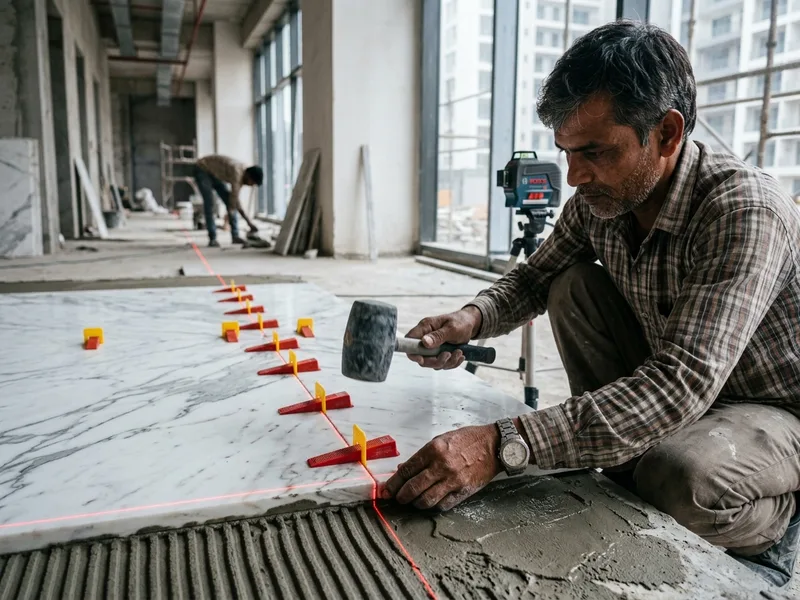
- Zero Lippage Specification: Uneven marble edges (lippage) are unacceptable in luxury hospitality. The client architect mandated a maximum tolerance of under 0.3mm across any 3-meter straight edge.
- Longevity & Chemical Stain Resistance: High foot-traffic, luggage trolley impact, and potential beverage spills required deep silicate pore-impregnation and chemical surface crystallization.
Execution Methodology: Dry-Grid Laying & Diamond Crystallization
Traditional wet-laying often produces unpredictable tonal shifts, lippage, and disjointed veining. Parth Enterprises deployed an engineered dry-grid installation sequence:
1. Dry-Grid Vein Matching & Numbering: Every imported 20mm Statuario and Bottocino slab was uncrated and laid dry on calibrated staging platforms in our controlled preparation area. Master stone artisans numbered each piece to correspond to an architectural CAD grid layout, aligning distinctive grey veining across main lobby walkways and grand atrium focal points. Slabs with micro-fissures were reinforced with epoxy mesh backing before cutting.
2. Substrate Leveling & Polymer Bonding: The existing base slab was mechanically diamond-ground to remove old adhesives, vacuumed, and treated with an SBR bonding primer. Slabs were bedded using EN 12004 C2TE S1-compliant deformable polymer-modified thinset adhesive applied with a 12mm notched trowel. Self-leveling threaded mechanical clip spacers were installed at all slab corners, guaranteeing absolute planar flatness with zero lippage.
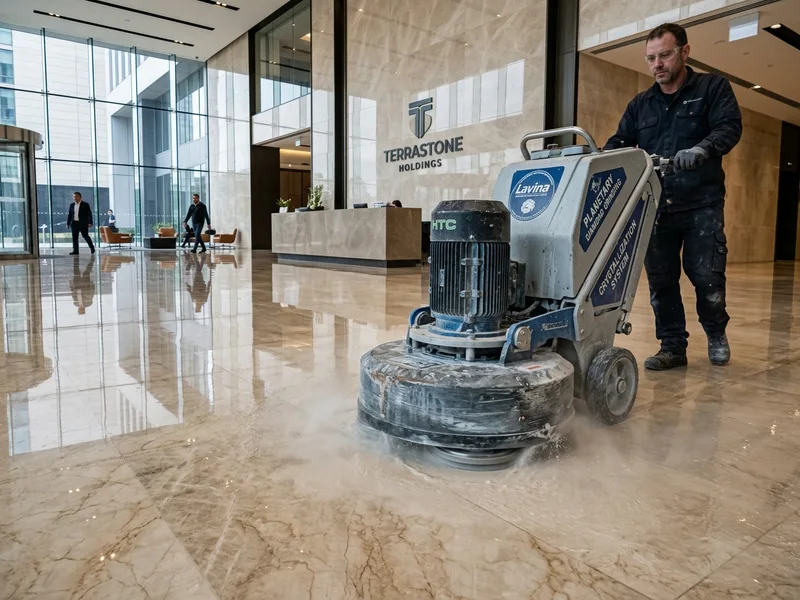
3. 7-Stage Planetary Diamond Honing & Silicate Crystallization: Once fully cured (72 hours), the floor underwent progressive diamond grinding using heavy multi-head planetary machines:
- Stage 1–2 (Coarse Grinding): 60-grit and 120-grit metal-bond diamonds to achieve complete planar uniformity across joint boundaries.
- Stage 3–4 (Fine Honing): 200, 400, and 800-grit resin-bond pads to eliminate micro-scratches and prepare pores for chemical hardening.
- Stage 5 (Pore Densification): Deep penetration of lithium silicate hardener to react with calcium carbonate in the stone, increasing surface abrasion resistance tenfold.
- Stage 6–7 (Thermo-Chemical Crystallization & Buffing): Fine polishing up to 3000 grit followed by planetary application of fluorosilicate crystallization compounds and high-speed natural horsehair buffing pads, yielding a glass-like 92+ GU reflective mirror sheen.
Material Specifications & Quality Control Matrix
| Component | Material / Specification | Technical Benchmark | Quality Verification Test |
|---|---|---|---|
| Primary Slabs | Italian Statuario & Classic Bottocino (20mm) | First-Choice Quarry Slabs (Carrara/Brescia) | Visual Vein Audit & Water Absorption <0.2% |
| Bonding Adhesive | Polymer-Modified Thinset Mortar (C2TE S1) | EN 12004 / IS 15477:2019 | Shear Adhesion Test >1.5 N/mm² |
| Joint Filler | Epoxy-Resin Stone Tinted Grout | Zero Shrinkage, Non-Yellowing | Color-Match Spectrophotometer Audit |
| Chemical Densifier | Colloidal Lithium Silicate Solution | Deep Capillary Penetration (3–5mm) | Mohs Hardness Verification (>4.5) |
| Crystallization | Fluorosilicate Thermo-Chemical Compound | High Chemical Resistance | Digital 60° Gloss Meter (92+ GU Benchmark) |
Hospitality Handover & Performance Review
The entire 25,000 sq.ft project was executed in seamless phased sections without a single guest complaint or disruption to daily hotel banqueting operations. Handed over to hotel general management and ownership on schedule, the restored marble surfaces have maintained their pristine, glass-reflective luster under heavy luggage and footwear traffic, underscoring Parth Enterprises' mastery of high-end architectural stone engineering. Learn more about our commercial delivery scope as a leading commercial construction company in Delhi NCR.