1. Engineered Structural Waterproofing: Beyond Residential Patch Repairs
Waterproofing in commercial, industrial, and institutional buildings is an uncompromising civil engineering discipline, not a cosmetic paint application. Commercial structures in Noida and Delhi NCR—such as multi-storey IT parks in Sector 62, high-density SEZs along the Noida-Greater Noida Expressway (Sectors 125 to 142), and industrial complexes in Sector 65—operate under severe hydrostatic, environmental, and thermal stresses. With basement floor plates extending 2 to 4 levels below grade into high alluvial water tables, uncontrolled moisture infiltration causes concrete carbonation, rebar corrosion, electrical substation hazards, and catastrophic structural degradation.
At Parth Enterprises, we execute engineered multi-tier waterproofing systems designed from the substrate outward. As a direct-execution commercial RCC and civil contractor, our engineers understand concrete pore structures, hydration kinetics, cold joints, and settlement kinetics. We eliminate the single largest cause of waterproofing failure in Delhi NCR: fragmented sub-contracting where applicators blame the civil contractor for substrate defects, and civil contractors blame the applicator for product failure.
| Structural Application Zone | Primary Exposure & Threat | Engineered System | Parth Quality Hold Point |
|---|---|---|---|
| Deep Basements & Rafts | 0.5 to 1.8 bar continuous hydrostatic pressure, groundwater chlorides, sulfates | Pre-applied HDPE composite membrane + Crystalline slurry + Swellable waterbars | 100% lap weld peel test + Joint waterstop alignment inspection before pour |
| Podium Decks & Plazas | Heavy vehicular wheel loads, dynamic vibrations, root penetration from landscape | Multi-layer elastomeric liquid PU + Anti-root barrier + Drainage cells + Protection screed | Substrate moisture test (<5%) + 48-hr hydrostatic flood ponding |
| Commercial Terraces & Roofs | Intense UV degradation, thermal shock (ΔT 45°C), standing rainwater pools | 3mm/4mm torch-applied APP modified bitumen membrane (dual layer) + 1:100 slope screed | Substrate pull-off test + 48-hr full ponding test with datum mark |
| Sunken Slabs & Wet Areas | Continuous moisture, chemical cleaning agents, multiple pipe penetrations | Two-component polymer-modified cementitious (PMC) + AR glass fiber mesh reinforcement | Pipe collar casting with non-shrink grout + 48-hr hydrostatic ponding |
| Structural Expansion Joints | Seismic movement (±25mm to ±50mm), cyclic thermal expansion and contraction | Hypalon elastomeric joint bandage tape with structural epoxy + Polysulphide sealants | Substrate grit blasting to CSP-3 + Elongation verification test |
2. Deep Basement & Substructure Tanking Systems
Substructure waterproofing in Noida commercial developments must withstand continuous hydrostatic water pressure. The alluvial floodplain hydrology flanking the Yamuna and Hindon rivers means that groundwater tables frequently rise to within 2.5 to 4.5 meters of natural ground level during the monsoon season. In multi-level basements, water exerts an upward hydrostatic pressure exceeding 15 to 25 kN/m² against raft slabs and horizontal thrust against retaining walls.
A. Positive-Side Tanking (Pre-Applied Membrane Architecture)
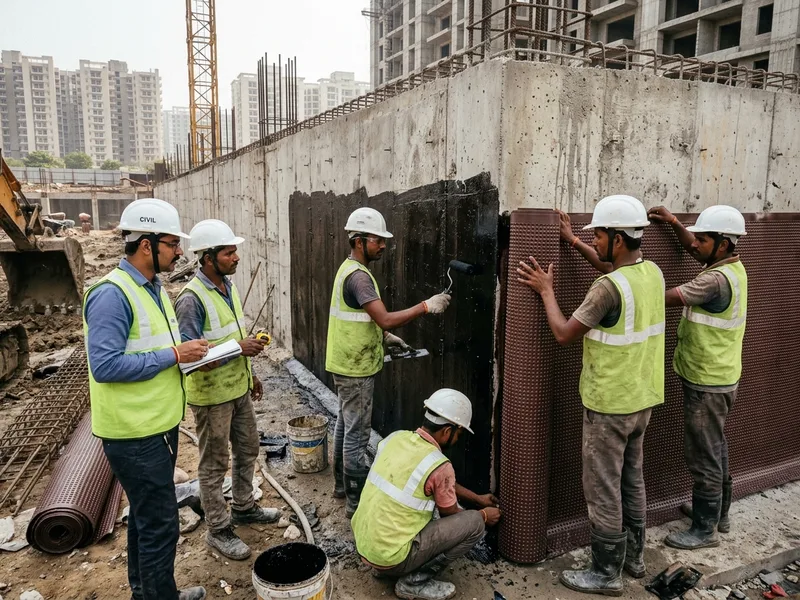
On new construction projects, positive-side waterproofing—applied on the exterior face of structural elements directly contacting the soil—is the definitive engineering standard. We deploy pre-applied fully bonded High-Density Polyethylene (HDPE) membranes. As concrete is poured against the membrane, the unhydrated cement slurry forms an irreversible mechanical and chemical bond with the pressure-sensitive adhesive layer, preventing water migration between the membrane and structural concrete even if localized punctures occur.
B. Dimpled Drainage Board & Geotextile Filtration Matrix
Along vertical retaining walls, we install high-density polyethylene (HDPE) dimpled drainage sheets bonded with non-woven polypropylene geotextile fabric. The dimples create a continuous 8mm to 10mm air gap that relieves hydrostatic head by funneling soil water rapidly down to the perimeter perforated sub-drain collector pipe network, significantly reducing the lateral water pressure exerted on the concrete structure.
3. High-Pressure Polyurethane (PU) Chemical Injection Grouting
When existing commercial basements suffer active water leaks, dampness patches, or running water bursts through retaining wall cracks, positive-side excavation is impossible without demolishing surrounding roads, landscape, and utility corridors. In these operational scenarios, Parth Enterprises deploys high-pressure polyurethane (PU) chemical injection grouting—the gold standard in commercial structural remediation.
Engineering Methodology of 250-Bar Injection Grouting:
- Hydrostatic Crack Diagnostics & Mapping: Our civil engineers map all active seepage cracks, cold joints, and honeycombing zones using thermal imaging and moisture meters to chart the exact subterranean water ingress trajectory.
- Staggered 45° Hole Drilling: High-tensile rotary hammer drills bore injection holes at a 45-degree angle to intersect the crack plane at the exact midpoint of the structural concrete thickness (typically 150mm to 300mm depth).
- High-Pressure Mechanical Steel Packers: Heavy-gauge steel packers equipped with non-return ball valves are inserted into the drilled holes and expanded mechanically using a torque wrench to ensure an airtight seal capable of holding pressures up to 300 bar.
- Polyurethane Resin Injection: Using dual-component electric high-pressure piston pumps, we inject hydrophobic or hydrophilic polyurethane resins at pressures ranging from 100 to 250 bar. Upon contacting groundwater inside the crack, the resin undergoes an instantaneous chemical reaction, expanding 15 to 30 times its original liquid volume into a dense, closed-cell elastomeric foam that completely displaces water and bonds molecularly to the concrete fissure walls.
- Secondary Hydrophobic Seal & Packer Removal: A secondary pass of low-viscosity non-foaming polyurethane injection resin is pumped to create an impermeable solid rubber core. After curing, packers are removed and the drill holes are packed flush with fast-setting polymer-modified crystalline mortar.
4. Commercial Podium Decks, Plaza Slabs & Landscaped Areas
Podium slabs in modern corporate campuses (such as IT parks in Noida Sector 62 and Sector 135) serve multifunctional demands: they function as roofs over subterranean parking basements while supporting heavy surface fire tenders, vehicular traffic, tree planters, water fountains, and intensive pedestrian hardscape. Standard residential waterproofing fails rapidly under these cyclic dynamic live loads and chemical fertilizers.
Our engineered podium deck assembly incorporates five critical defense layers: 1) Structural RCC slab prepared by mechanical captive shot blasting to Concrete Surface Profile (CSP) 3; 2) Fast-curing epoxy-polyurethane primer; 3) Multi-layer elastomeric liquid polyurethane (PU) membrane applied to a monolithic continuous minimum Dry-Film Thickness (DFT) of 1.8mm to 2.2mm, boasting 450%+ elongation capacity to absorb structural deflection; 4) Root-barrier polyethylene slip sheets underneath all landscaped planter boxes to prevent tree root penetration; 5) High-compressive-strength (400+ kPa) cuspated drainage cells overlaid with 150 GSM non-woven geotextile filter fabric, topped by an engineered reinforced protection screed.
5. Commercial Terraces, Roofs & Parapet Water Management
Rooftop waterproofing in Noida must endure extreme weather conditions: summer surface temperatures reaching 65°C on exposed concrete roofs, followed by torrential monsoon downpours that drop temperatures by 30°C in minutes. This extreme thermal cycling causes severe expansion and contraction stresses that rip rigid cementitious coatings apart.
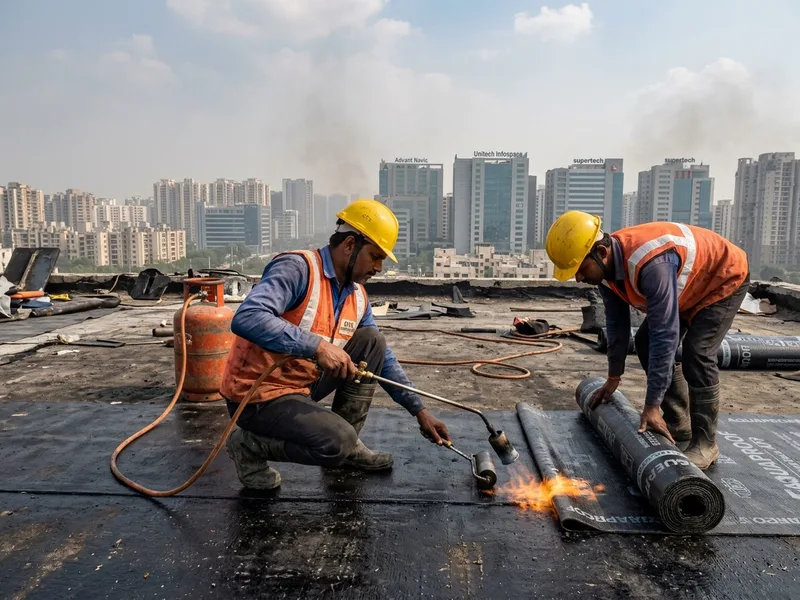
We deploy torch-applied Atactic Polypropylene (APP) or Styrene-Butadiene-Styrene (SBS) polymer-modified bitumen waterproofing membranes. Featuring high-tensile non-woven spunbond polyester reinforcement (minimum 160 to 200 g/m²), our 3mm and 4mm APP membranes provide exceptional puncture resistance, tear strength, and low-temperature flexibility. All membrane laps are thermofused using LPG flame torches with a mandatory 100mm side overlap and 150mm end overlap, forming a monolithic continuous impervious sheet. Before membrane application, we cast an engineered slope gradient screed (minimum 1:100 fall) towards heavy-duty cast-iron rainwater drain outlets, eliminating standing water pools permanently.
6. Sunken Slabs, Kitchens & High-Density Commercial Wet Areas
Commercial washrooms, cafeteria kitchens, and executive pantries in multi-tenant corporate facilities house high-density plumbing stacks, drain manifolds, and grease traps. Water leakage through a commercial sunken slab damages executive false ceilings and electrical networks on the tenant floor below, creating legal liabilities and business disruption.
Parth Enterprises executes a rigorous 4-step sunken slab protocol: 1) Core-cutting and pipe penetration sleeves are sealed with non-shrink high-strength structural grout (50+ MPa) and fitted with hydrophilic swellable rubber collar gaskets; 2) Casting of smooth 75mm x 75mm polymer-modified cementitious fillets (coves) at all floor-to-wall 90-degree junctions to eliminate stress concentrations; 3) Dual-coat application of two-component polymer-modified cementitious (PMC) elastomeric coating reinforced with an alkali-resistant 45 g/m² woven fiberglass mesh embedded between coats; 4) Mandatory 48-hour hydrostatic flood ponding test before lightweight cinder or clinker backfilling and protective screed casting.
7. Construction Joints, Cold Joints & Expansion Joint Systems
Over 80% of water ingress in commercial concrete structures occurs not through the solid concrete mass, but through discontinuities: construction pour joints, daywork kicker joints, tie-rod holes, and structural expansion joints. Concrete shrinkage, thermal cycles, and ground settlement inevitably focus stress at these natural break lines.
We implement a comprehensive active joint protection strategy: 1) Hydrophilic swellable bentonite-butyl waterbars installed centrally along all construction joints, engineered to swell up to 300% upon water contact to block capillary pathways; 2) Perforated re-injectable grouting hose systems fastened along critical slab-to-retaining wall kicker joints, allowing low-viscosity resins to be pumped directly into the joint months after concrete pour if any dampness is detected; 3) Multi-ply Hypalon/EPDM elastomeric bandage expansion joint tapes bonded with two-component structural epoxy adhesive across seismic gaps, capable of accommodating multi-directional structural drift without tearing.
8. Featured Landmark Project: The Trapezoid IT Park (C-27, Sector 62, Noida)
A benchmark demonstration of our commercial waterproofing and civil execution inside an active technology campus is The Trapezoid IT Park (C-27, Sector 62, Noida). Operating inside a live corporate IT complex in Sector 62's shallow groundwater zone required phased hydrostatic seepage control, sunken wet-core tanking, and substrate rehabilitation without disrupting tenant operations.
The Trapezoid IT Park — Subterranean & Wet-Core Waterproofing Package
Addressing monsoon groundwater pressure across subterranean joints, retaining surfaces, and sunken service cores inside an occupied Sector 62 IT facility while keeping tenant lobbies, elevators, and parking operational.
Targeted polyurethane injection grouting at construction cold joints, deep-penetrating crystalline slurry treatment on retaining substrates, multi-coat polymer-modified wet-core tanking, and protective cementitious screeds.
Mechanical V-groove joint preparation, non-shrink polymer mortar coving (gola) at all slab-to-wall junctions, off-hour drilling schedules to preserve daytime office quietness, and calibrated multi-coat DFT curing checks.
Dry substrate integrity verified via 48-hour hydrostatic ponding tests on sunken wet zones and joint PMC inspection sign-off prior to architectural granite and lobby stone installation.
Eliminated active moisture ingress across treated subterranean and wet-core zones, enabling seamless handoff to lobby stone flooring and elevator portal cladding teams.
9. Commercial Waterproofing Cost Guide & Project Pricing in Noida (2026 Benchmarks)
Transparent estimation and itemized measurement governed by IS 1200 (Part VIII) are central to our client partnerships. Commercial waterproofing costs depend on structural depth, exposure severity, chemical resin formulation, and warranty duration.
| Waterproofing System | Benchmark Cost | Key Specifications & Material | Typical Application |
|---|---|---|---|
| Polymer-Modified Cementitious (PMC) | ₹45 – ₹75 / Sq.Ft | 2-coat acrylic/SBR modified cement slurry, 1.2mm DFT, AR glass fiber mesh, 48-hr ponding | Internal sunken toilets, utility balconies, service shafts |
| APP Torch-Applied Bitumen Membrane | ₹85 – ₹145 / Sq.Ft | 3mm/4mm polymer-modified bitumen, 160g/m² polyester reinforcement, 100mm welded laps | Commercial rooftops, machine room terraces, exposed slabs |
| Liquid Polyurethane (PU) Elastomeric | ₹160 – ₹280 / Sq.Ft | Aliphatic/aromatic polyurethane, 1.8mm-2.2mm DFT, 450% elongation, UV stable, root barrier | Landscaped podium decks, corporate plaza hardscape, driveways |
| High-Pressure PU Injection Grouting | ₹850 – ₹1,800 / Point | 250-bar steel mechanical packers, hydrophobic/hydrophilic fast-reacting resin, non-shrink plug | Active basement leaks, retaining wall cold joints, diaphragm walls |
| Crystalline Deep-Penetrating Slurry | ₹55 – ₹95 / Sq.Ft | Catalytic chemical crystalline treatment, reacts with unhydrated lime, self-heals up to 0.4mm | Water storage tanks, swimming pools, basement negative-side slabs |
10. Technical Specifications & IS Codal Standards Matrix
At Parth Enterprises, all commercial waterproofing design, surface preparation, chemical blending, and quality inspections strictly adhere to the national codal frameworks published by the Bureau of Indian Standards (BIS):
| Codal Standard & Code | Regulatory Scope & Engineering Requirements | Parth Quality Hold Point |
|---|---|---|
| IS 3370 (Parts 1 to 4) | Code of practice for concrete structures for storage of liquids: permissible crack widths (<0.1mm), minimum cement content, expansion joint placement, and impermeability testing. | Permeability test (DIN 1048) ± Joint inspection before concrete pour |
| IS 1346:1991 | Code of practice for waterproofing of roofs with bitumen felts: substrate preparation, minimum slope gradients (1:100), flashing height (minimum 300mm), and protective screed casting. | Slope verification via water-level & bull-mark screeds + 48-hour hydrostatic flood test |
| IS 2645:2003 | Specification for integral waterproofing compounds for cement mortar and concrete: water absorption reduction (>50%), compressive strength preservation, and setting time compliance. | Batch test certificate verification + Slump and cube strength testing |
| IS 1200 (Part VIII) | Method of measurement of building and civil engineering works: strict itemized measurement separating surface preparation, priming, membrane, protection screed, and joint treatments. | Joint measurement sheet sign-off with client PMC |
11. 5-Stage Waterproofing QA/QC & 48-Hour Hydrostatic Flood Testing Protocol
Waterproofing cannot be inspected by visual estimation alone; latent pinholes, unbonded laps, and micro-fissures only manifest under sustained hydrostatic head. Parth Enterprises enforces our proprietary 5-Stage Waterproofing Quality Protocol across all Noida job sites:
- Stage 1 — Substrate Profiling & Moisture Testing: Mechanical grinding, wire brushing, or vacuum grit blasting to achieve Concrete Surface Profile (CSP) 2 to 4. Substrate moisture content is verified using electronic impedance moisture meters (<5% moisture mandatory before primer application).
- Stage 2 — Joint Coving & Penetration Detailing: All right-angle corners receive 75mm x 75mm polymer-modified mortar chamfers. Plumbing pipe cutouts are chased, packed with non-shrink structural grout, and sealed with elastomeric collars.
- Stage 3 — Primer & Multi-Layer Membrane Execution: Chemical primers are applied to penetrate 2mm to 4mm into the concrete pore network. Membranes are thermofused or applied in cross-directional passes to achieve verified uniform thickness.
- Stage 4 — Wet & Dry-Film Thickness (WFT/DFT) Verification: Calibrated wet-film comb gauges and sq.m material consumption logs verify membrane coating thickness against project specifications across a 5m x 5m measurement grid.
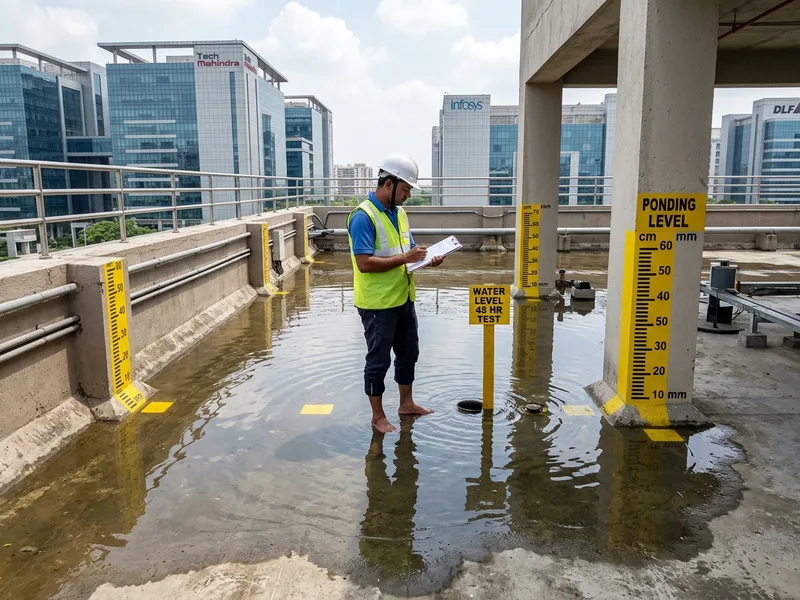
- Stage 5 — Mandatory 48-Hour Hydrostatic Flood Ponding Test: Slabs are bunded with 100mm brickwork or sandbags and flooded with clean water to a minimum depth of 50mm to 75mm. Water level gauges are logged at 0, 12, 24, 36, and 48 hours. The underside of the structural slab is rigorously inspected for dampness, efflorescence, or weeping. Protection screeds are cast only after formal PMC sign-off on the flood certificate.
12. Project Delivery Timelines & Phased Execution Milestone Schedule
Commercial waterproofing must coordinate directly with overall civil construction or fit-out schedules to prevent critical path delays. Parth Enterprises deploys Critical Path Method (CPM) scheduling to execute phased, zoned handovers:
| Treatment Area | Standard Schedule | Fast-Track Phasing | Critical Milestones |
|---|---|---|---|
| 10,000 to 25,000 Sq.Ft (Terrace) | 10 to 14 Days | 7 Days (2-Shift Crew) | Surface prep → Screed curing → Torch membrane → 48-hr flood test → Handover |
| 30,000 Sq.Ft (Podium Deck) | 20 to 25 Days | 14 Days (Zoned Multi-Crew) | Zone A primer & PU coat while Zone B completes shot blasting; phased protection screed |
| 1,00,000+ Sq.Ft (Deep Basement) | 30 to 45 Days | 24 Days (Parallel Rigs) | Raft pre-applied HDPE → Retaining wall spray PU → Drainage board → Backfill clearance |
13. Monsoon Emergency Preparedness & High-Water Table Engineering in Noida
Executing waterproofing in Gautam Buddha Nagar requires intimate understanding of local soil strata. The geological positioning of Noida—wedged between the Yamuna River to the west and the Hindon River to the east—creates high groundwater tables across Sectors 62, 63, 65, and the Noida-Greater Noida Expressway (Sectors 125 to 142). During the monsoon (July to September), river recharge causes groundwater tables to surge upwards by 1.5 to 3.0 meters, exerting peak hydrostatic head on commercial basement envelopes.
Parth Enterprises maintains active dewatering and emergency waterproofing response squads throughout the monsoon season. For commercial facility managers facing unexpected basement leaks, server room flooding, or lift pit seepage, our technical response teams mobilize with 250-bar high-pressure injection pumps, fast-reacting water-stop polyurethane resins, and submersible slurry pumps to arrest running leaks within hours.
14. Commercial Waterproofing Tender Checklist: Scoping an Accurate Project Estimate
For corporate procurement officers, architects, and PMCs preparing to tender a commercial waterproofing package in Noida and Delhi NCR, ensuring that your tender specifications cover all critical hold points prevents contractor corner-cutting and disputes.
- Substrate Preparation Standards: Specify mechanical grinding or grit blasting to CSP-3; forbid chemical washing without pH neutralization.
- Membrane Weight & DFT: Mandate minimum 3mm/4mm torch-applied membrane with ≥160g/m² polyester, or liquid PU minimum 1.8mm DFT.
- Joint Detailing Clauses: Itemize separate rates for 75mm x 75mm polymer fillets, swellable waterbars, and expansion joint Hypalon bandages.
- Mandatory 48-Hour Flood Test: Include a non-negotiable contractual clause requiring joint PMC sign-off on 48-hour flood ponding before screeding.
- 5-to-10-Year System Performance Warranty: Require a formal stamped warranty certificate backed by contractor defect liability and manufacturer MTCs.
Hire Waterproofing Contractor Desk
Share your basement, terrace, podium, or building area details to get a clear itemized waterproofing contract quote within 48 hours.
Get Waterproofing Contract Quote →Call Contractor Directly
Speak directly with our waterproofing engineering team to schedule a site leak inspection on your property.
Call Contractor: +91 9205618348WhatsApp Contractor Desk
Send basement seepage or roof leakage photos and slab dimensions on WhatsApp for quick guidance.
WhatsApp ContractorCommercial Waterproofing Contractors in Noida, Gurgaon & Delhi (2026 System Matrix)
High Yamuna flood-plain water tables in Noida and East Delhi, perched rocky seepage pockets in Gurgaon's Aravali belt, and aging rooftop screeds across Connaught Place, Okhla, and Nehru Place require engineered multi-coat systems rather than brush-applied retail coatings. Operating as direct waterproofing contractors in Noida, waterproofing contractors in Delhi, and heavy basement specialists for waterproofing in Gurgaon, Parth Enterprises backs every commercial installation with a mandatory 48-to-72-hour hydrostatic flood test (IS 3370) and a 5-to-10-year system warranty.
| Waterproofing System | 2026 NCR Supply + Apply Rate | Technical Specification | Warranty |
|---|---|---|---|
| 2-Coat Polymer Cementitious (Sunken/Wet Areas) | ₹52 – ₹78 / sq.ft | Acrylic/SBR polymer slurry + glass-fiber mesh + 300mm cove fillet | 5 Years |
| 3mm / 4mm Torch-On APP Bitumen Membrane | ₹85 – ₹135 / sq.ft | Bituminous primer + 100mm lap torch fusion + geotextile & slope screed | 7 – 10 Years |
| Elastomeric Liquid PU Terrace Membrane | ₹120 – ₹185 / sq.ft | 1.5mm DFT single-component polyurethane + UV aliphatic topcoat (400%+ elongation) | 10 Years |
| Crystalline Negative Basement Tanking + PU Grouting | ₹135 – ₹260 / sq.ft | Packer-injected hydrophobic PU foam + active crystalline capillary matrix seal | 10 Years |
Calculate Terrace & Basement Waterproofing Quantities Online
Size exact chemical, membrane roll, primer, and protection screed budgets using our Terrace, Sunken & Basement Waterproofing Cost Calculator, or combine structural waterproofing with Commercial Building Repair & Renovation across Noida, Delhi, and Gurgaon.
Estimate Material Quantities & 2026 Rates Before Tendering
Use our Indian Standard compliant Waterproofing Cost Calculator to compute instant site quantities, wastage allowances, and preliminary budgets—or browse all 17 engineering calculators.